## Why It Works
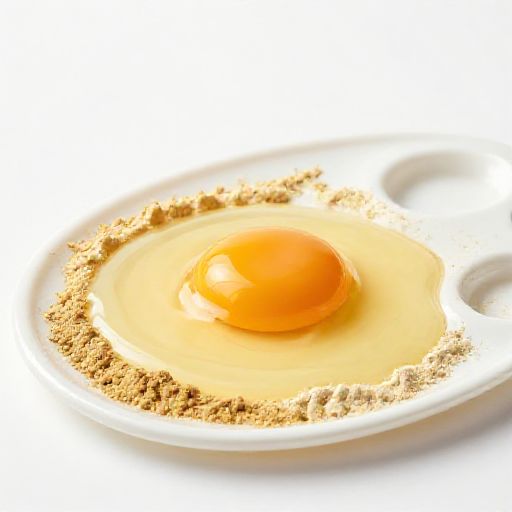
Egg yolk contains proteins, fats, lecithin, and water in a naturally stable emulsion. When mixed with dry pigment and applied to a prepared surface, the yolk's water content keeps the paint workable, while the proteins and fats create a binding matrix that locks the pigment in place as they dry and polymerize. Over time, the yolk proteins cross-link further, becoming increasingly hard and insoluble — which is why egg tempera paintings from the 1400s still look vivid. No modern synthetic binder has matched this long-term stability.
## The Full Story
Egg tempera was the dominant painting medium in Europe from the Byzantine era through the early Renaissance, roughly the 5th through 15th centuries. Painters applied it to wooden panels prepared with gesso (chalk and rabbit skin glue) in thin, hatched strokes. The paint dries within seconds, so blending is nearly impossible — artists built color gradually through layering thousands of fine crosshatch strokes.
The transition to oil painting (perfected by Jan van Eyck in the early 1400s) allowed longer working time and easier blending, which changed what was possible in painting. But tempera never fully disappeared. Andrew Wyeth painted almost exclusively in egg tempera through the 20th century, and contemporary artists still use it for its unique luminous quality.
To make egg tempera today: separate an egg yolk, puncture the yolk sac and squeeze it into a small container, discarding the membrane. Mix with dry pigment powder in a 1:1 ratio by volume. Add a few drops of water to adjust consistency. Apply to a primed surface. Clean brushes with water immediately — dried tempera is nearly impossible to remove.
## Pro Tips
- Work in thin layers only. Thick applications crack as the paint dries and the outer surface shrinks faster than the interior.
- Traditional surfaces: hardwood panels with gesso ground. Paper and canvas work for practice but are less archivally stable.
- The yolk of a larger, free-range egg has a higher fat content and produces richer, more flexible paint than supermarket eggs.
## When to Use This
For artists interested in historical technique, anyone who wants a fast-drying water-soluble paint with extraordinary permanence, or simply for the experience of using the same medium that produced some of the greatest paintings in human history.