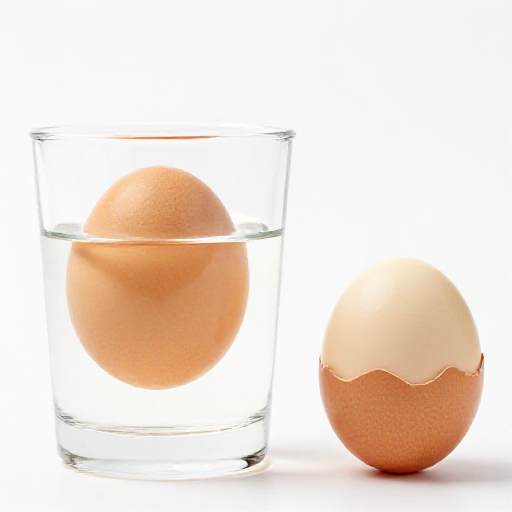
## Why It Works
Every egg contains an air cell at the blunt end, sealed inside the shell. As the egg ages, moisture and carbon dioxide escape through thousands of microscopic pores in the shell, and outside air moves in to replace them. The air cell grows. More air means more buoyancy. The float test is just Archimedes' principle applied to your breakfast.
## How to Do It
1. Fill a glass or bowl with cold water — deep enough to fully submerge an egg.
2. Gently lower the egg into the water. Do not drop it; a hairline crack will throw off the result.
3. Read the position:
- **Sinks flat on its side** — very fresh, under one week old. Use for poaching or frying where presentation matters.
- **Sinks but tilts or stands at an angle** — 1 to 2 weeks old. Perfectly fine for any use.
- **Stands upright on the bottom** — 3 to 4 weeks old. Still edible, best for hard-boiling (older eggs actually peel easier).
- **Floats** — too much air inside. Discard it.
4. Pat the egg dry before using if it passed.
## Pro Tips
- A floating egg is not automatically rotten — it could just be very old. Crack it into a separate bowl and smell it before you decide. If it smells fine, use it for baking where freshness matters less.
- The float test has a real false-positive rate. An egg can float and still be edible, or sink and be borderline. The sniff test at the crack is the definitive check.
- Shell cracks will let water in and throw the buoyancy reading. If you see bubbles rising from the egg, it has a crack and the test is invalid.
## When to Use This
Use the float test when you've lost track of when you bought eggs — which, honestly, is most of the time. It's also useful when you have eggs from multiple cartons mixed together, or when buying farm-fresh eggs that weren't refrigerated and don't carry a date. Takes ten seconds and saves you from cracking a bad egg into a finished batter.