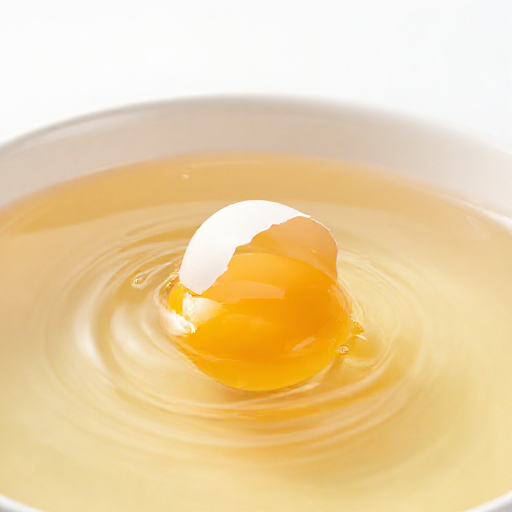
## Why It Works
When you drop an egg into still water, the white disperses outward in all directions before it has a chance to set — you get a flat, ragged poached egg with wispy tendrils. The vortex wraps the white inward and around the yolk as the centripetal motion carries it. The white coagulates in that wrapped position, producing a compact, round result. This only works with fresh eggs because fresh egg whites are thick and viscous. Old egg whites have a higher water content and disperse too quickly for the vortex to contain them.
## How to Do It
1. Fill a saucepan with at least 3 inches of water. Add a splash of white vinegar (optional — helps the white set faster, no flavor).
2. Heat to just below a simmer: small bubbles clinging to the bottom, water shimmering. Not a rolling boil — turbulence breaks the egg apart.
3. Crack your egg into a small bowl or ramekin first. This lets you slide it in precisely.
4. Use a spoon to stir the water in a brisk circle, creating a clear vortex.
5. Let the vortex spin for a few seconds to become stable.
6. Gently slide the egg from the bowl into the center of the vortex.
7. Leave it alone for 3 to 4 minutes. No poking, no stirring.
8. Lift with a slotted spoon. Blot dry on a paper towel.
## Pro Tips
- This technique works well for one or two eggs at a time. For batch poaching, use the advance-poach-and-reheat method instead.
- The vinegar accelerates white coagulation and produces a tighter result. Use just a tablespoon per quart — you won't taste it.
- If the yolk breaks during the vortex drop, you can still save it — the white will hold whatever shape it lands in, and a broken-yolk poached egg still tastes fine.
## When to Use This
Eggs Benedict, any dish where presentation matters, or any time you want a proper poached egg rather than a sad watery disc.